Anker vs EcoFlow vs Bluetti vs Jackery
Four popular power station brands, four different approaches to portable electricity, and one important question: which one deserves your money? Anker, EcoFlow, Bluetti, and Jackery have become familiar names for anyone looking to power appliances, charge electronics, or prepare for electricity outages. But choosing between them isn't as simple as picking the biggest battery. Some models charge faster, others deliver higher power output, and certain stations are much easier to carry.
Shoppers can also explore discount codes available on Shoppingspout Australia to save on qualifying purchases and enjoy affordable shopping without stretching their budget. This comparison takes a closer look at what separates these brands, including their popular products, battery performance, charging technology, and practical features.
Key Strengths at a Glance
- Highest AC output: Anker SOLIX C1000 Gen 2 (2,000W)
- Quickest full recharge: Anker SOLIX C1000 Gen 2 (about 49 minutes)
- Largest built-in capacity: Bluetti AC180 (1,152Wh)
- Most expandable: EcoFlow DELTA 3 (up to about 5kWh)
- Lightest: Jackery Explorer 1000 v2 (10.8kg)
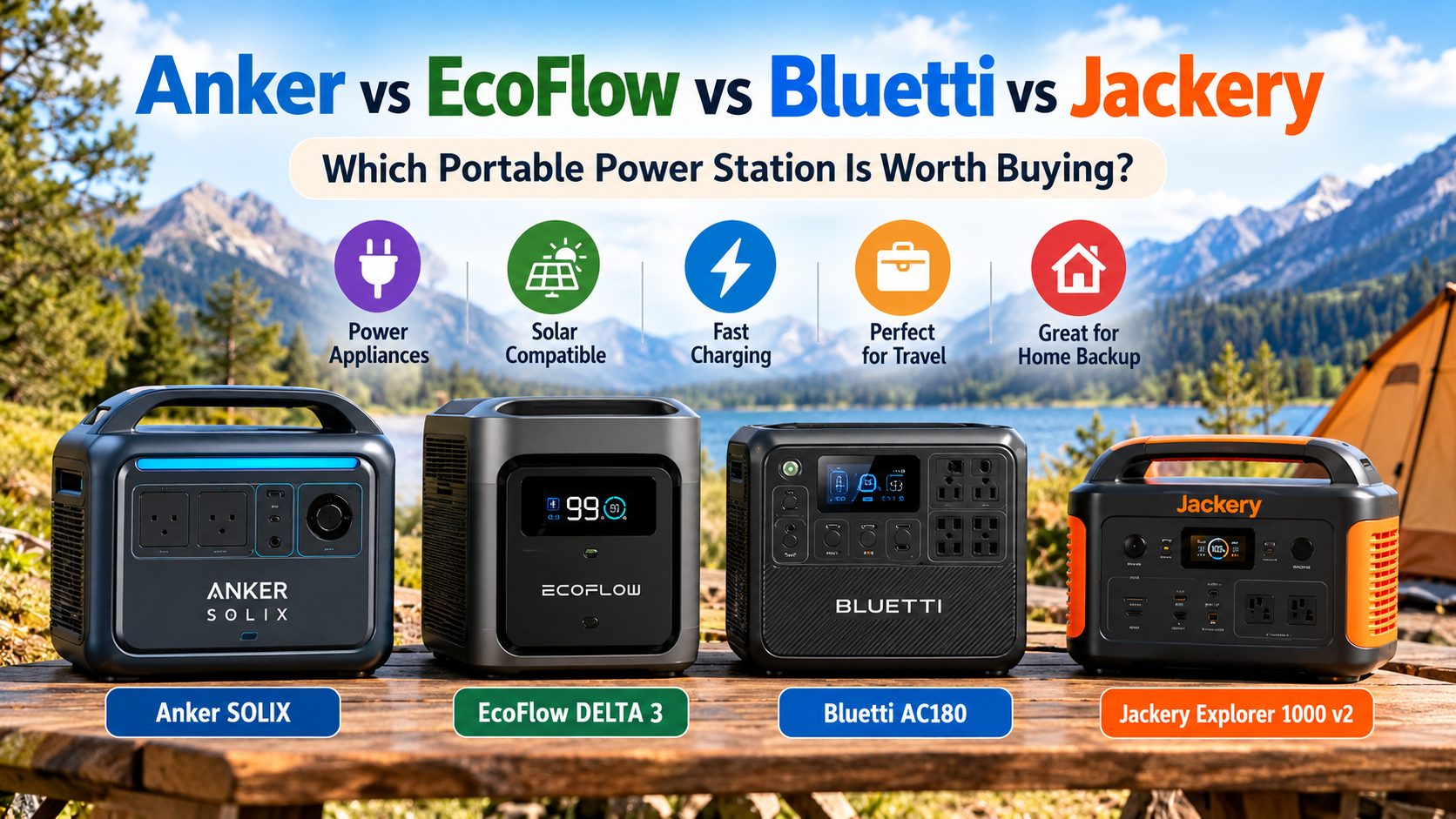
Anker vs EcoFlow vs Bluetti vs Jackery – Key Differences at a Glance
After their initial look at portable power stations, they appear to be pretty much identical. All of them come with a power socket, battery and the power level indicator. However, it's when you compare them side by side that you begin to see some big differences. Here are a few examples: the Anker SOLIX C1000 Gen 2, the EcoFlow DELTA 3, the Bluetti AC180, and the Jackery Explorer 1000 v2. They all share approximately 1,000Wh of battery storage, but that's as far as the similarities go. Have a look at the specs, though, and some very useful differences will be discovered that set them apart.
Choosing the right portable power station depends on how much power you need and where you plan to use it. If running high-powered appliances is your priority, Anker offers models with impressive AC output. For those who need longer backup power and greater battery capacity, Bluetti has several options worth considering. Meanwhile, Jackery is a practical choice for camping, road trips, and outdoor adventures, especially for anyone looking for a portable power station that's easy to carry and use. EcoFlow stands out for its expandable DELTA ecosystem and smart app-based energy management. What this means is that no brand is better than the other, and it is easier to compare certain products rather than assuming one brand is better than another.
Meet Anker SOLIX, EcoFlow, Bluetti, and Jackery: Four Different Approaches to Portable Power
Anker's SOLIX line is based on their knowledge of charging tech. From small power stations that keep your devices running to larger battery systems to power your entire home. One that is particularly interesting is the SOLIX C1000 Gen 2 - 2,000W and very portable. Some models include quick USB-C charging ports, phone control via an app and even solar-powered charging, to help you keep your devices powered throughout the day.
EcoFlow is about portable electricity that is easy and fast. They offer two principal power stations, the RIVER series is ideal for smaller jobs, while the DELTA series can power larger jobs and multiple appliances. Plus, some DELTA models can be paired with additional batteries for extra power when needed.
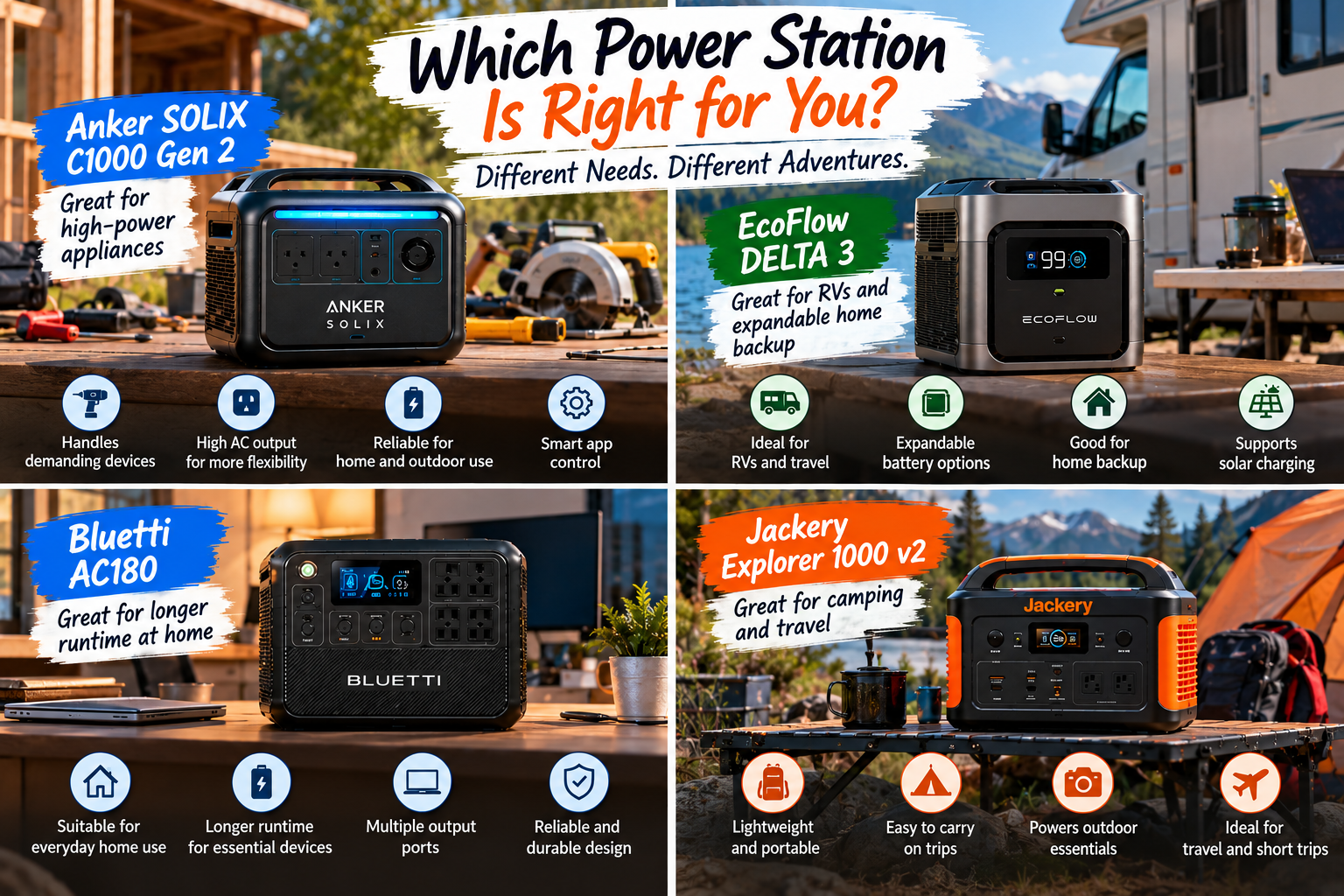
Bluetti offers a variety of portable power stations available for storing energy and using solar panels. The AC180 stores 1,152Wh and delivers 1,800W at its strongest. However, if you require more, Bluetti also has larger systems with the capacity to store more energy. If you want to go "off the grid," there are models available that are fairly compatible with solar panels as well as models that are expandable to store more energy.
Jackery Explorer portable power stations are designed for convenience, making them a practical choice for camping, road trips, and outdoor adventures. The Jackery Explorer 1000 v2 weighs around 10.8kg, making it the lightest option among the four models being compared. Despite its portable design, it offers a 1,070Wh battery capacity, providing a useful balance between power storage and ease of carrying. Jackery also offers SolarSaga solar panels that work with compatible power stations, allowing users to recharge their devices using solar energy while outdoors. For added convenience, the brand provides solar generator bundles that combine portable power stations with solar panels, making them a suitable choice for off-grid trips and outdoor activities.
Anker SOLIX vs EcoFlow DELTA vs Bluetti AC180 vs Jackery Explorer: Battery Capacity and Power Output
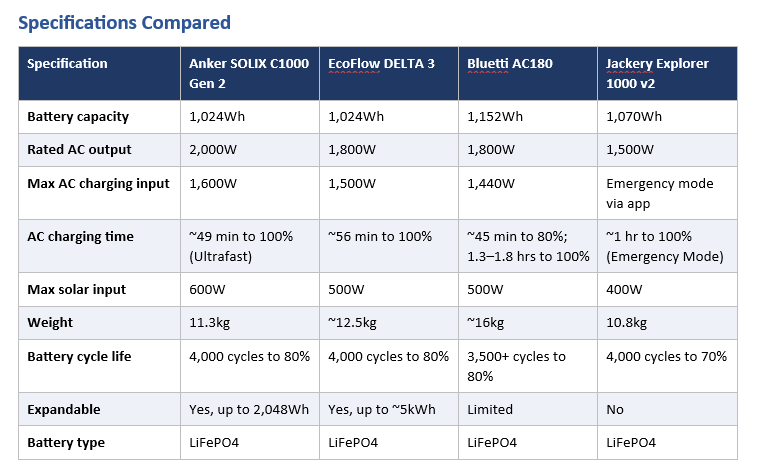
When it comes to batteries, a larger battery would appear to be the best option, but it's not. You see, battery capacity and power output are two different things. The ability to store electricity is measured in terms of capacity (in watt-hours). Similarly, power output, measured in watts (W), determines how much electricity a portable power station can supply at a given time. For comparison, the Bluetti AC180 delivers 1,800W of power, while the Anker SOLIX C1000 Gen 2 offers 2,000W, making both practical options for running household appliances and electronic devices. The Bluetti can store 1,152Wh of energy, while the Anker can store 1,024Wh - which means that the Bluetti can store more energy. Power-wise, however, the Anker packs in 2000W of rated AC power, while the Bluetti has 1800W. The Anker’s higher wattage (2,000W) means more power at any one time. The Bluetti’s larger capacity (1,152Wh) means it can run a device for longer.
In terms of power output, the EcoFlow DELTA 3 offers 1,800W of power and the Jackery Explorer 1000 v2 has a power output of 1,500W. These power stations are excellent for charging laptops, lighting up rooms or even to power a portable refrigerator (depending on the power station you are using). If you have several heavy-duty devices to plug into, however, you'll have to pay attention to the power limits. The 100W unit, for instance, could operate for approximately 10 hours from a 1,024Wh battery, but in reality, this will likely be less because of power losses. So it is not simply about the size of the battery you can buy but the correct size and power of a battery which is suitable for you.
Anker vs EcoFlow Charging Speed – How Bluetti and Jackery Compare
One of the features that can be much more convenient is charging speed of a portable power station. In the meantime, Anker SOLIX C1000 Gen 2 can handle up to 1,600W AC power in its UltraFast mode with a full AC charge taking around 49 minutes, and EcoFlow DELTA 3 reaches a full AC charge in around 56 minutes with a specified 1,500W input. For customers who need to top off their equipment often and don't like the idea of leaving a station plugged in to a wall outlet for a few hours, both are a consideration.
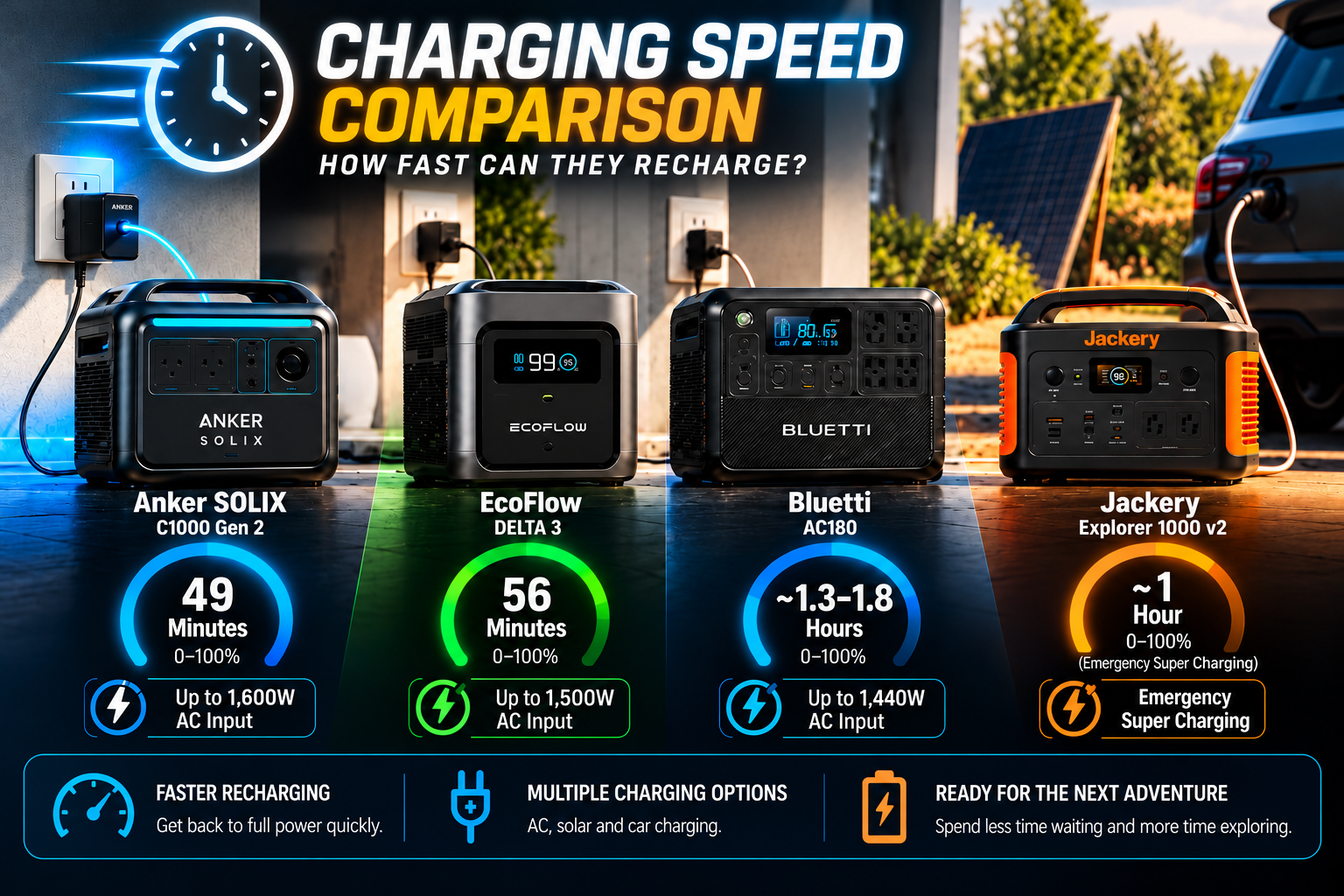
The Jackery Explorer 1000 v2 can recharge from 0–100% in about 59 minutes using Emergency Super Charging, activated in the Jackery app. The Bluetti AC180 supports 1,440W Turbo Charging, reaching 80% battery capacity in just 45 minutes and a full charge in approximately 1.3–1.8 hours.
But maximum charging input does not necessarily mean that the time required for full charging is known. This is affected by battery capacity, charging parameters and manufacturer specifications. Customers ought to compare the published charging times under similar conditions and particularly when choosing fast charging or regular battery maintenance.
Bluetti vs EcoFlow Solar Generators & Where Anker and Jackery Stand
Portable power stations can charge their batteries from solar power, providing an alternative source of energy to relying exclusively on wall outlets. The maximum solar input for Bluetti AC180 is 500W, and for EcoFlow DELTA 3, it's also 500W. Both of these models have less of a published solar input limit than Anker SOLIX C1000 Gen 2, which has a solar input limit of 600W. Jackery Explorer 1000 v2 also supports solar panels that are compatible with it, such as the SolarSaga brand.
But the input from the sun is only part of the story. Customers should also review the compatibility of panels, voltage restrictions, connectors and charging requirements. If a station can support a greater solar input, it may recharge faster with an appropriate panel setup, but will be constrained by the power generated by the panels. When it comes to expandable battery capacity, the EcoFlow DELTA 3 leads with up to approximately 5kWh, followed by the Anker SOLIX C1000 Gen 2 at 2,048Wh, while the Jackery Explorer 1000 v2 has no expansion battery support.
Jackery vs Anker Portability: Comparing EcoFlow and Bluetti Designs
A portable power station may offer impressive specifications, but its weight can make a big difference when carrying it on camping trips, road trips, or outdoor adventures. For shoppers looking for around 1,000Wh of battery capacity without adding too much weight, comparing all four models is important. The Jackery Explorer 1000 v2 is the lightest at 10.8kg, followed by the Anker SOLIX C1000 Gen 2 at 11.3kg. The EcoFlow DELTA 3 weighs approximately 12.5kg, while the Bluetti AC180 is the heaviest at 16kg. This makes Jackery and Anker more convenient for frequent travel, while EcoFlow and Bluetti may appeal to users who prioritise other features over portability.
These differences can become significant if the user takes a camping vacation or goes RVing or moves from one location to another. If the user has to carry the device around, it seems the Jackery station will be more suitable, but if the user wants a higher-rated AC output, the Anker station has a slightly higher weight. In this comparison, Bluetti station comes with some added weight and energy stored. The customer should also note the handling design, size, placement of outlets and storage space.
EcoFlow, Anker, Bluetti, and Jackery; Smart Features, Battery Lifespan
Portable power stations have developed into a much more sophisticated device compared to a battery that has electric outlets. EcoFlow DELTA models allow using application to control charging and select certain parameters, and compatible Anker SOLIX and Bluetti devices feature connected capabilities to check the battery charge and manage available parameters. Jackery also provides similar features in some newer Explorer devices. Such features might be quite handy for people who would like to monitor their energy consumption or use the power station without constant observation of its display.
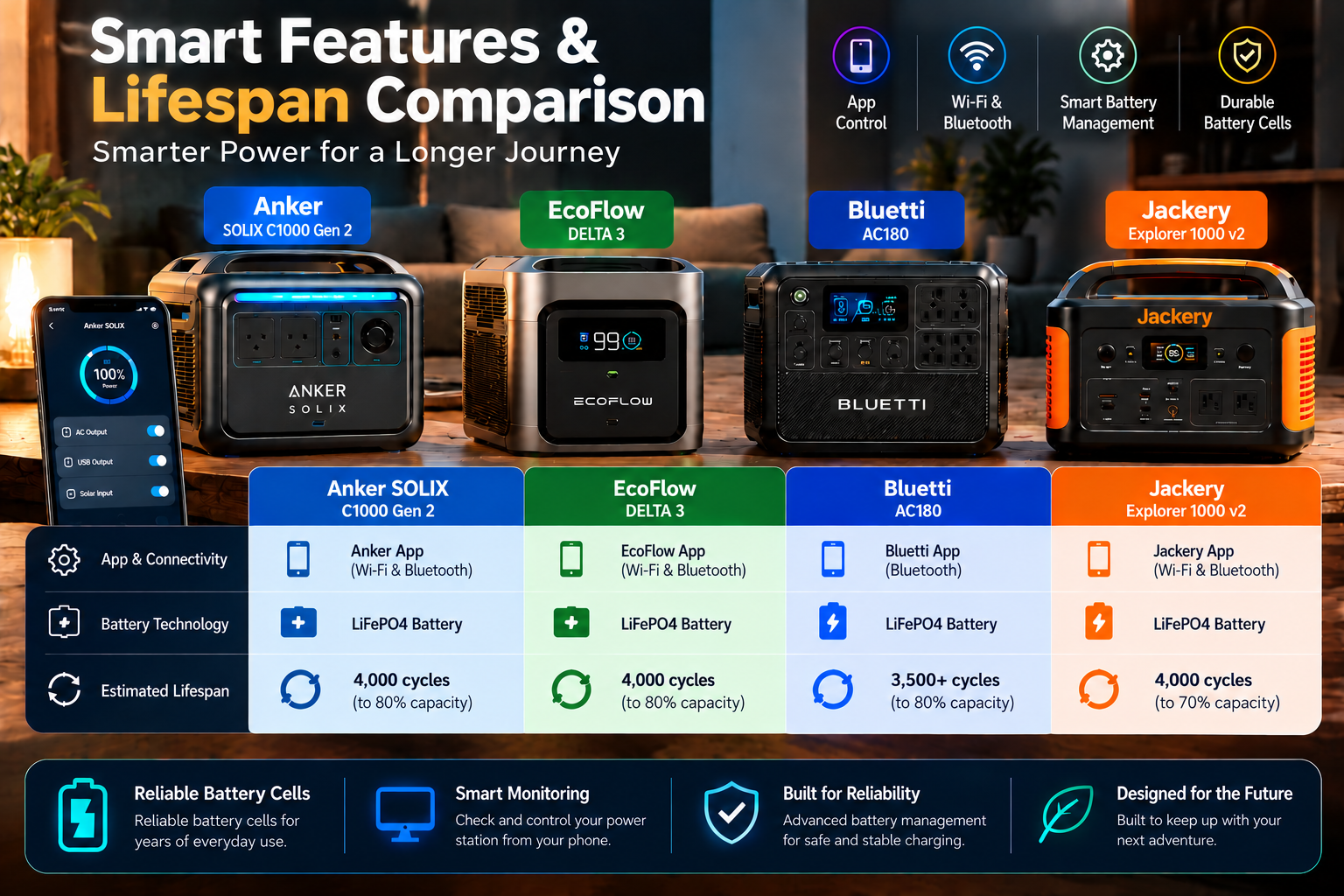
Battery lifespan is another important factor when comparing portable power stations, especially for those planning to use them regularly. The EcoFlow DELTA 3 and Anker SOLIX C1000 Gen 2 are both rated for 4,000 charging cycles while retaining at least 80% of their original battery capacity. The Bluetti AC180 offers more than 3,500 cycles before reaching 80% capacity, while the Jackery Explorer 1000 v2 is rated for 4,000 cycles with at least 70% capacity remaining. Although all four models are designed for long-term use, EcoFlow and Anker stand out for their higher capacity retention after 4,000 cycles, making them appealing options for frequent charging and extended use.Warranty conditions also vary among manufacturers, device models, and countries of purchase. Evaluation of battery remaining capacity specifications, warranty terms, and compatibility of accessories provides a more realistic comparison of value than comparing cycle-life specifications only.
Anker vs EcoFlow vs Bluetti vs Jackery – Best Options for Camping, RVs, and Home Backup
Different situations call for different power station features, and the best option for camping may not be the most suitable choice for home backup. Instead of choosing by brand popularity, it helps to match the equipment to the intended use.
For camping: Jackery Explorer 1000 v2 offers a relatively lightweight design, while compact Anker SOLIX and EcoFlow RIVER stations are also worth considering for charging phones, cameras, laptops, and lighting.
For RVs and road trips: EcoFlow DELTA and selected Bluetti models offer useful capacity and charging options for portable refrigerators, electronics, and other compatible appliances. Larger Anker SOLIX and Jackery Explorer products provide alternatives for more demanding travel setups.
For home backup: Higher-capacity Anker SOLIX, EcoFlow DELTA, Bluetti, and Jackery systems can support essential household devices when their output and battery capacity meet the requirements.
For solar-powered setups: Bluetti and EcoFlow provide various solar-compatible systems, while Anker SOLIX and Jackery offer compatible charging options and accessories. Solar input limits and battery capacity should guide the choice.
For any of these uses, appliance wattage and expected runtime matter more than brand recognition. A station with enough energy to charge several phones may not have the output needed for a high-demand appliance, while a powerful station with limited capacity may run that appliance for only a short time.
Anker, EcoFlow, Bluetti, or Jackery: Which Brand Offers Better Value for Money?
Money's worth does not necessarily mean getting the least expensive power station. Anker SOLIX C1000 Gen 2 provides the most powerful AC output out of the four, giving it an edge for those consumers requiring increased power from a portable station. EcoFlow DELTA 3 adds fast charging capability and connectivity into the mix, while Bluetti AC180 boasts the highest battery capacity that is built into the device itself. Jackery Explorer 1000 v2, on the other hand, is the lightest of the four, which might be an important factor for those consumers traveling often. The wisest buy lies in finding the balance between capacity, charging speed, portability, and features against the price. A consumer who intends to charge only their laptop would likely not require an expandable and large system.
Which Is Better? Anker, EcoFlow, Bluetti, or Jackery
There is no one winner among Anker, EcoFlow, Bluetti, and Jackery, but each of the brands provides an interesting angle to choose one of their power stations. In particular, Anker SOLIX C1000 Gen 2 is notable for its 2,000W rated output power, EcoFlow DELTA 3 offers fast charging, smart app control and the most expansion potential (up to about 5kWh), Bluetti AC180 has plenty of battery capacity, and Jackery Explorer 1000 v2 is a lightweight model for easy transportation. What one needs to use depends on whether the customer would like to power heavy loads, store more energy, charge faster, or have a lighter product. The choice of the portable power station requires careful consideration, but it does not mean spending more than intended initially when shopping. Discounts provided by Shoppingspout can be used to make purchases cheaper for those who have them at hand.
Last updated: 23 October 2026
Information in this comparison reflects manufacturers’ published specifications at the time of writing. Products may be updated or revised over time, so confirm current specifications on each brand’s official Australian website before buying.